Chapter nine · about five minutes
The bills that do not come every month
The insurance renewal, the license, the software you pay yearly. You knew about every one of them all year, so none of them should get to wreck a month. One division makes them boring.
By Issa and the IssaBudget team
The ambush you saw coming
It is a perfectly ordinary month until the insurance renewal lands in it. Nothing about the month was wrong. The work was steady, the envelopes were doing their jobs, and then one bill arrived carrying a whole year on its back.
It feels like an emergency, and it is nothing of the kind. You knew the amount and you knew the date, both of them, all year. Chapter two called this bill what it is: not a bigger cost than a monthly one, just the same cost arriving in a lump.
A real emergency is chapter six’s territory, the thing you could not have seen coming. A renewal with a date printed on it does not qualify, and treating it like one drains a fund built for genuine surprises.
Once a year still means every month
Here is the whole trick, and it is one division. Take the yearly amount, divide it by twelve, and give that bill an envelope you fund every month like a small rent.
Say the insurance renews at $600 a year. That is $50 a month. A $120 license is $10 a month. Software billed at $240 a year is $20. Three ambushes just became one boring $80 line that every month can carry, and when each bill lands, its envelope is full and simply pays it. The month the bill arrives in stops mattering at all.
This is what chapter four meant by counting the once-a-year bills as “a twelfth of each of them every month.” And you already run this exact machine: your income tax envelope fills a little every month so a big bill can land on it later. Same idea, smaller bills, known dates.
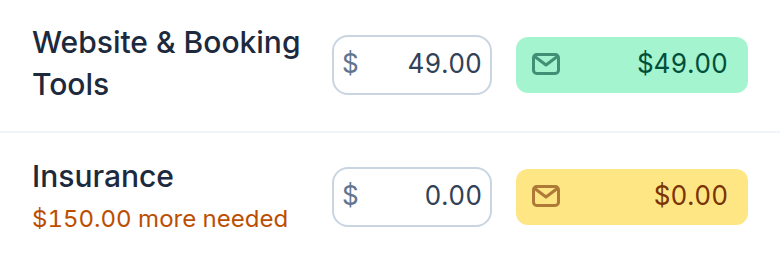
In the app this is an envelope target: the amount and the date the bill lands. It works out what each month needs to set aside and shows the envelope filling toward the date, so on the day the bill arrives the money is sitting there with its name on it.
Starting late in the year
One honest wrinkle, and it only exists in your first year. Twelfths assume you have twelve months, and you probably do not. If the $600 renewal is four months away, a $50 habit arrives $400 short.
So the first year divides by the months you actually have: $600 over four months is $150 a month until the renewal lands, and from then on it relaxes to the easy $50 forever. Steeper for a season, boring for life. The app does this arithmetic for you when the date is close.
Three things that look alike, and only one is a cost
Setting money aside each month can mean three different things, and confusing them is how an owner feels broke while the account has money in it, or feels rich the week before three bills land.
The insurance renewal
- What it is
- A cost. Already spent, just not gone yet.
- Where it comes from
- Out before your pay, with the rent and the tax share.
- If money gets tight
- It still gets funded. Skipping it is not saving, it is a lapse.
The new lamp
- What it is
- A choice. A thing you want for the studio.
- Where it comes from
- Out of profit, competing with your own pay at the split.
- If money gets tight
- It waits. Being able to wait is what makes it a choice.
The holiday
- What it is
- Personal. A life goal, not a studio one.
- Where it comes from
- Out of your own pay, at home, like anyone else saves.
- If money gets tight
- Your call entirely, and the business never feels it.
The order matters because chapter four’s arithmetic runs on it. Call the lamp a cost and the business looks poorer than it is, the profit shrinks on paper, and your own pay shrinks with it, for a thing you merely wanted. Call the insurance a choice and it gets skipped in a lean month, and an insurance that lapses is not a bill you saved. It is a risk you took without deciding to.
A cost is funded before you are paid. A choice competes with your pay. Anything personal comes out of it. Three envelopes, three rules, no arguments at midnight.
When the choice is a machine rather than a lamp, the free tool Is this machine worth buying? weighs it the honest way: what it costs, what a session brings in and uses up, how many you can really book a month, and how many months of work pay it off.
What these envelopes are not
Like the income tax envelope, the once-a-year envelopes are holding pens, not savings. The money in them is already spent and simply has not left yet, which is why chapter five keeps them shut in a tight month and chapter six refuses to count them as cushions. They do sit still for months at a time, so chapter seven’s rule applies: they can wait somewhere that pays interest, as long as it is part of your plan.
The year gets quiet
Run this for a full year and something changes that is worth naming. There are no more expensive months. January costs what July costs. Every bill you could see coming has been dissolved into a flat, boring monthly amount, and the only surprises left are the genuine ones, which is exactly what your emergency fund was built for.
Which leaves the money you could not schedule: the everyday spending that decides, quietly, how much profit there is to split at all. Spending less is the other half of profit. That is the next chapter.