Chapter three · about four minutes
Write it down while it is warm
The minute after a client pays is worth more than any other minute in your week. Not because the minute is precious, but because of what it saves you from carrying.
By Issa and the IssaBudget team
The work nobody counts
Somewhere between the last client and the drive home, your brain starts doing sums. Was that a good week. Can the studio afford the thing you keep looking at. Did last month actually make anything, or did it only feel busy.
That thinking is work. It happens in the car, in the shower, at two in the morning. Nobody pays you for it, and here is the part that matters: it never arrives anywhere.
Why it never arrives
It cannot arrive, because the numbers are not written down. Your brain is being asked to remember every payment, every card fee, every quick supply run, going back weeks, and then do arithmetic on all of it while you are doing something else.
Nobody can do that. Not one person. So the question stays open, and an open question comes back tomorrow, and the day after.
An open question costs more than a closed one. It just charges you in small pieces, all month long.
What stays unanswered
Books that are three weeks behind cannot answer any of these, and these are the four questions a studio actually runs on.
None of those are hard questions. They are only unanswerable, and they are unanswerable for one small reason.
While it is still warm
When a client pays you, write it down before the next one sits in your chair. Right then, while it is warm, you still have all of it without looking anything up.
Four things, in the order the screen asks them. Who it was. What they handed over. What you did for them. What the card company took on the way through.
That last one is the one people skip, and it is what chapter two was about. A total with no fee beside it looks like a bigger number than you were actually paid, and a bigger number is not a kindness. It is just a wrong one.
By the evening, some of that is guesswork. By the following week it is archaeology, and by the end of the month it is a shoebox.
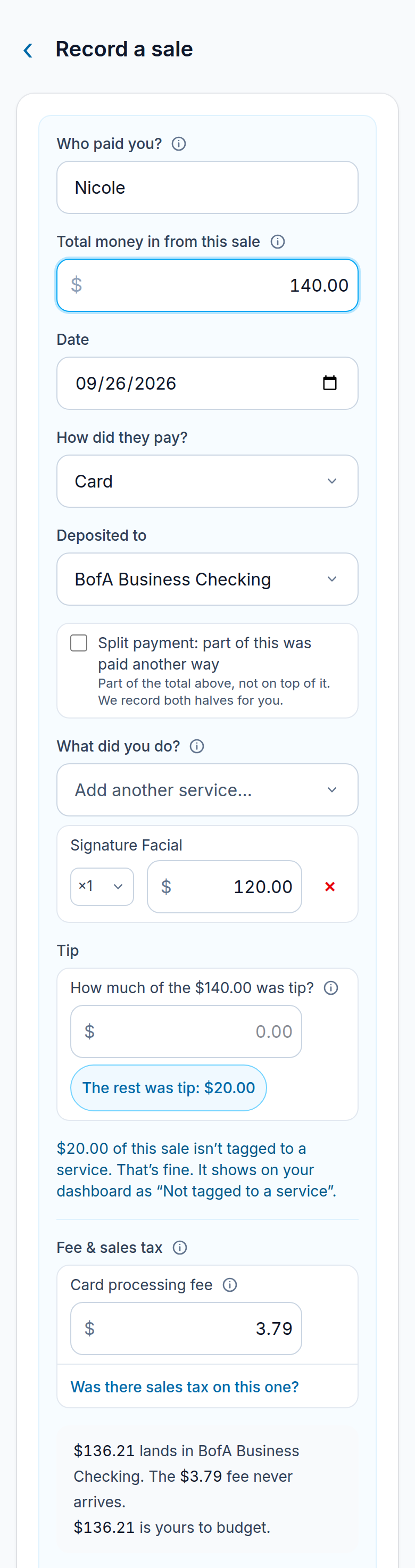
One screen, about a minute. That is the whole errand, and it is the only habit this app really asks of you.
The pile is what people quit over
Here is the trap, and it is worth seeing clearly, because it is the reason this gets away from almost everyone.
One sale takes a minute. Thirty sales take an afternoon, and an afternoon is a thing you have to schedule, and a thing you schedule is a thing you move. So it waits again, and now there are forty. Nobody ever quit over the minute. People quit over the afternoon.
Doing it warm is not about being organized. It is about never letting the pile exist in the first place.
What a month of this buys you
Thirty days from now, the four questions up there stop being questions. You open your plan and the answer is already sitting there, because you wrote it down when you knew it.
You will also stop doing the sums in the car. Not because you tried to stop, but because the question closed, and a closed question does not come back.
And the next time somebody asks whether you can afford something, you will not have to guess, or promise yourself you will work it out later. You will simply know, the way you know what is in your own fridge.
Nobody is asking you to work harder here. You are being asked to put down something you have been carrying for no reason.