Chapter four · about five minutes
Paying yourself on purpose
Chapter two said your pay comes out of the profit. This is the part it left open: how much, and how to get the same amount every month out of a business that gives you a different amount every month.
By Issa and the IssaBudget team
The most common way to get paid badly
Most owners pay themselves the same way. A little on Friday because the account looks alright. A bit more when the car needs something. Nothing at all in a quiet month, because it did not feel like the moment.
That is not a decision. It is a leftover. And a leftover has a habit of getting smaller, because everything else got decided first and got to go first.
Whatever is left over is not a wage. It is a remainder, and remainders shrink.
Your home does not have quiet months
Your studio has bills that arrive whether the week was busy. So does your home. The rent, the groceries and the car payment have never once asked how the bookings looked.
So the goal is not to take what you can. It is to get the same amount every month, on purpose, out of a business that never gives you the same amount twice.
First, what the business actually left you
Start where chapter two ended. What came in, less what the appointments cost you to deliver, less the bills that arrive whether you work or not. The once-a-year ones count too, a twelfth of each of them every month, or the number you finish with is flattering rather than true. What is left is the profit.
Then take out the income tax share, because part of that profit was never yours to keep.
Give it an envelope of its own, your income tax envelope, and leave it there. That envelope is not savings and it is not a cushion. You are holding money that already belongs to the tax bill, and the only thing you have to do is not spend it in the meantime.
How big your share should be, and the second tax some studios collect without noticing, is chapter eight.
Do that for each of the last six months. You will end up with six numbers.
Then take the average
Add the six together and divide by six. That is what your business has really been giving you, month after month, once the tax is out.
Take a slice of that average for the cushion chapter six is about, and set it aside. Chapter six gives that cushion a size and a monthly amount, so the slice is a number you look up, not one you guess. What is left is your pay. Write the number down.
A slightly smaller pay that quietly builds something behind you beats a larger one that leaves you nothing to fall back on.
Six months by hand is a real afternoon. The free tool What can I pay myself? works the same number from three figures you already know, a typical month, a slow month and what the studio costs, and gives the cushion its monthly amount too.
The envelope that holds the difference
No month will land on your number exactly, so the difference needs somewhere to live. It is an envelope like any other. Call it your salary buffer.
A month that comes in over your number puts the extra into it. A month that comes in under takes the difference out, and your pay arrives whole anyway. You never skip a month, and you never take a windfall either.
If you gave money a “quiet months” job back in chapter one, this is that envelope. What it was missing was a rule, and it just got one.
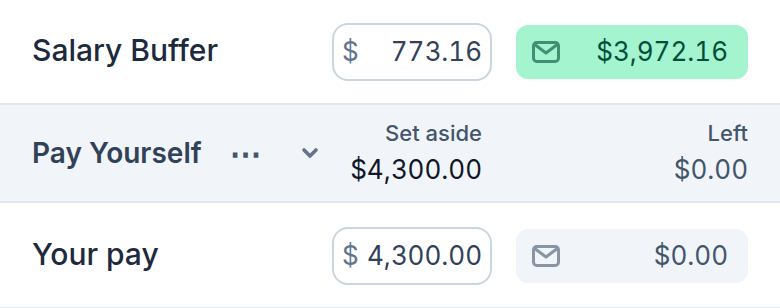
The same number, every month
Here is an example. Six months, what the business left after the income tax share and the cushion slice: $3,600, $5,100, $4,700, $3,500, $4,800 and $4,100. Added together they come to $25,800. Divided by six, $4,300. That is the pay, and here is what those same six months look like against it.
Your pay, every month: $4,300
| Month | What the business left you | Your monthly pay | Your salary buffer |
|---|---|---|---|
| JunJune | $3,600 | $4,300 | took out $700 |
| JulJuly | $5,100 | $4,300 | put in $800 |
| AugAugust | $4,700 | $4,300 | put in $400 |
| SepSeptember | $3,500 | $4,300 | took out $800 |
| OctOctober | $4,800 | $4,300 | put in $500 |
| NovNovember | $4,100 | $4,300 | took out $200 |
Six months later the buffer is back where it started, and you were paid $4,300 every single time.
Three months came in over the number and three came in under. June was $700 short, so the buffer covered it. July ran $800 over, so that went back in. Nothing had to be decided in the moment, and the pay landed at $4,300 six times out of six.
Before you start
You have a number now, and it is a good one. What you do not have yet is any of the things that keep it standing: how to begin while the buffer is still empty, how to tell whether the number is right, and what to do on the month it does not hold.
That is next, and it matters more than the arithmetic you just did. A pay number without those three is a plan that works beautifully until the first quiet month.